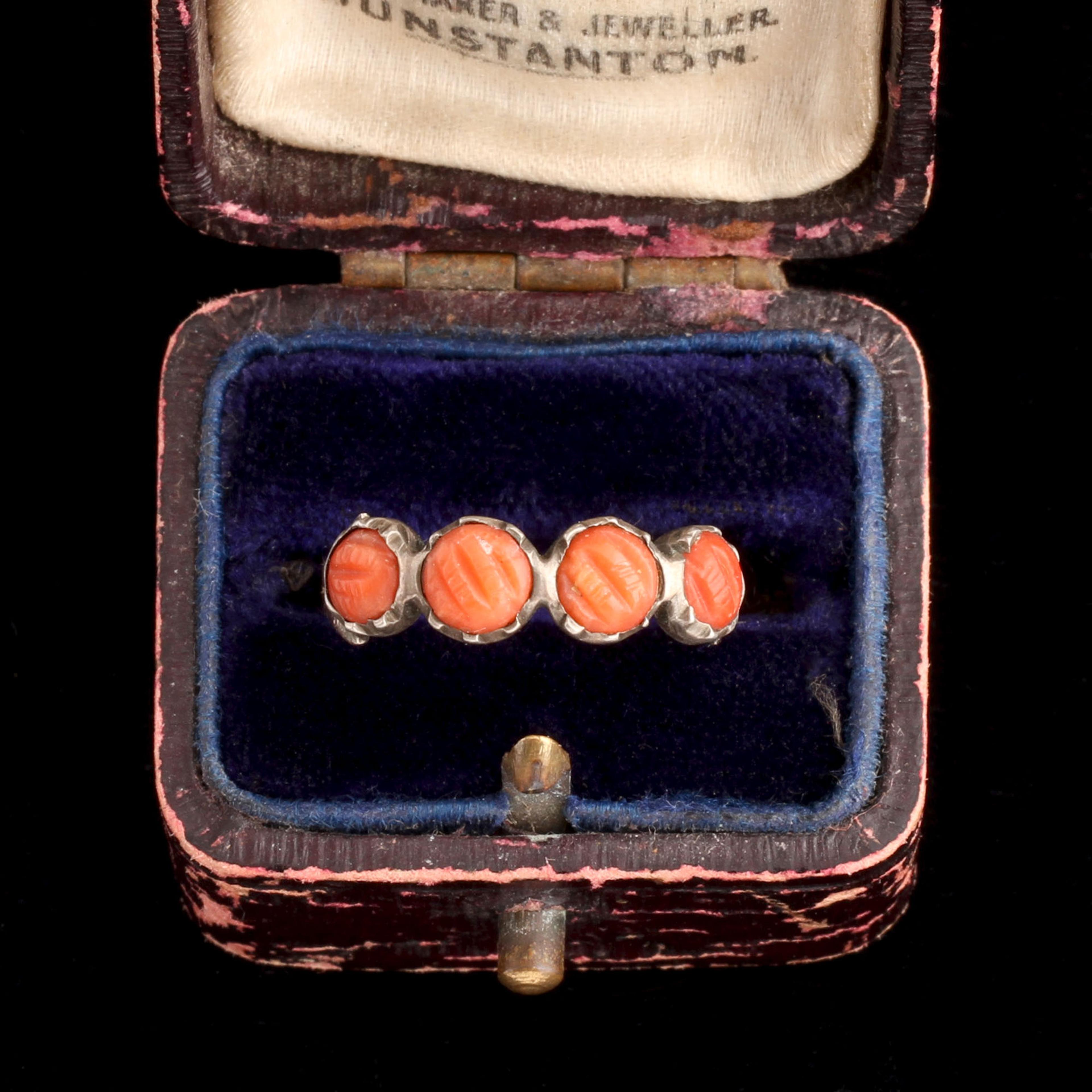
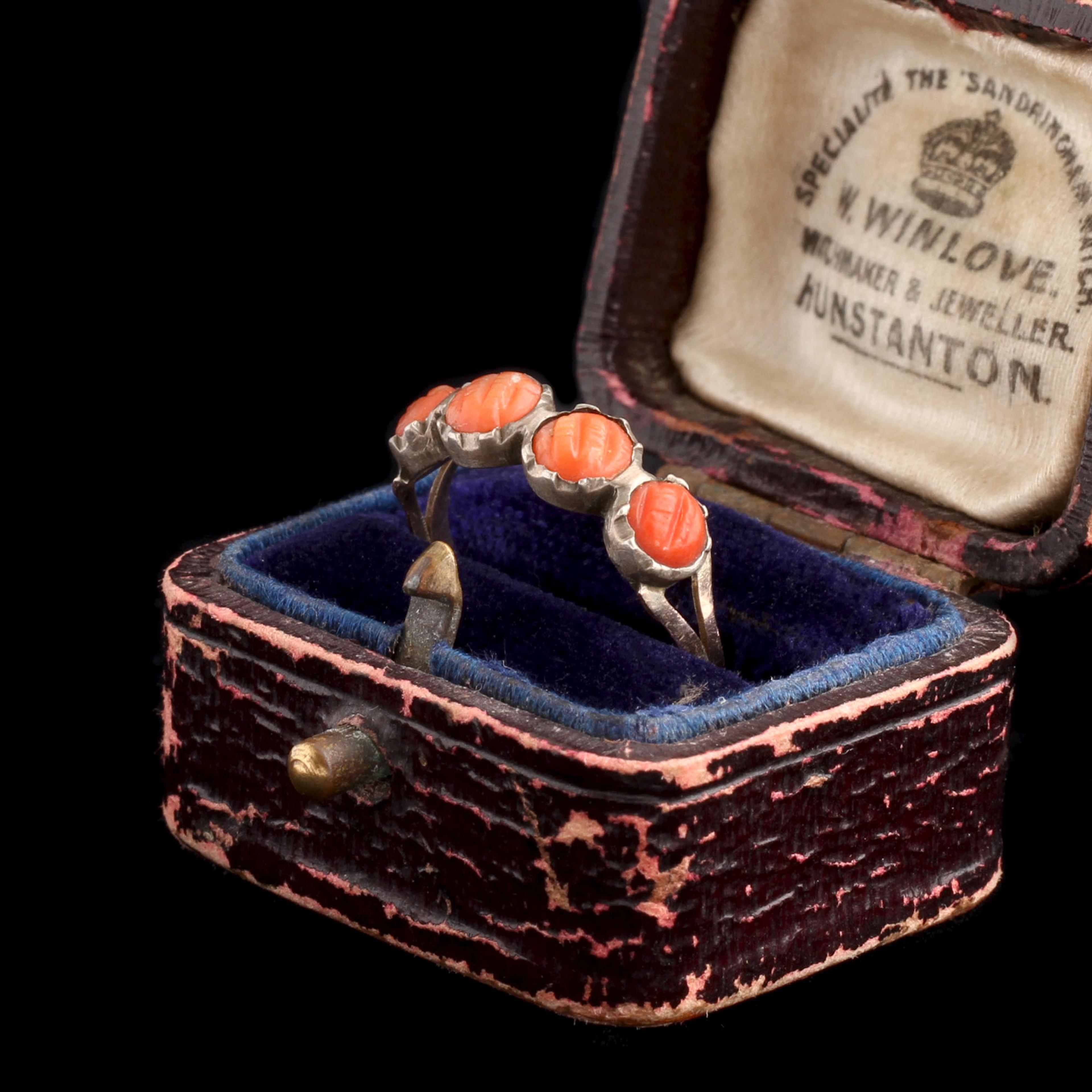
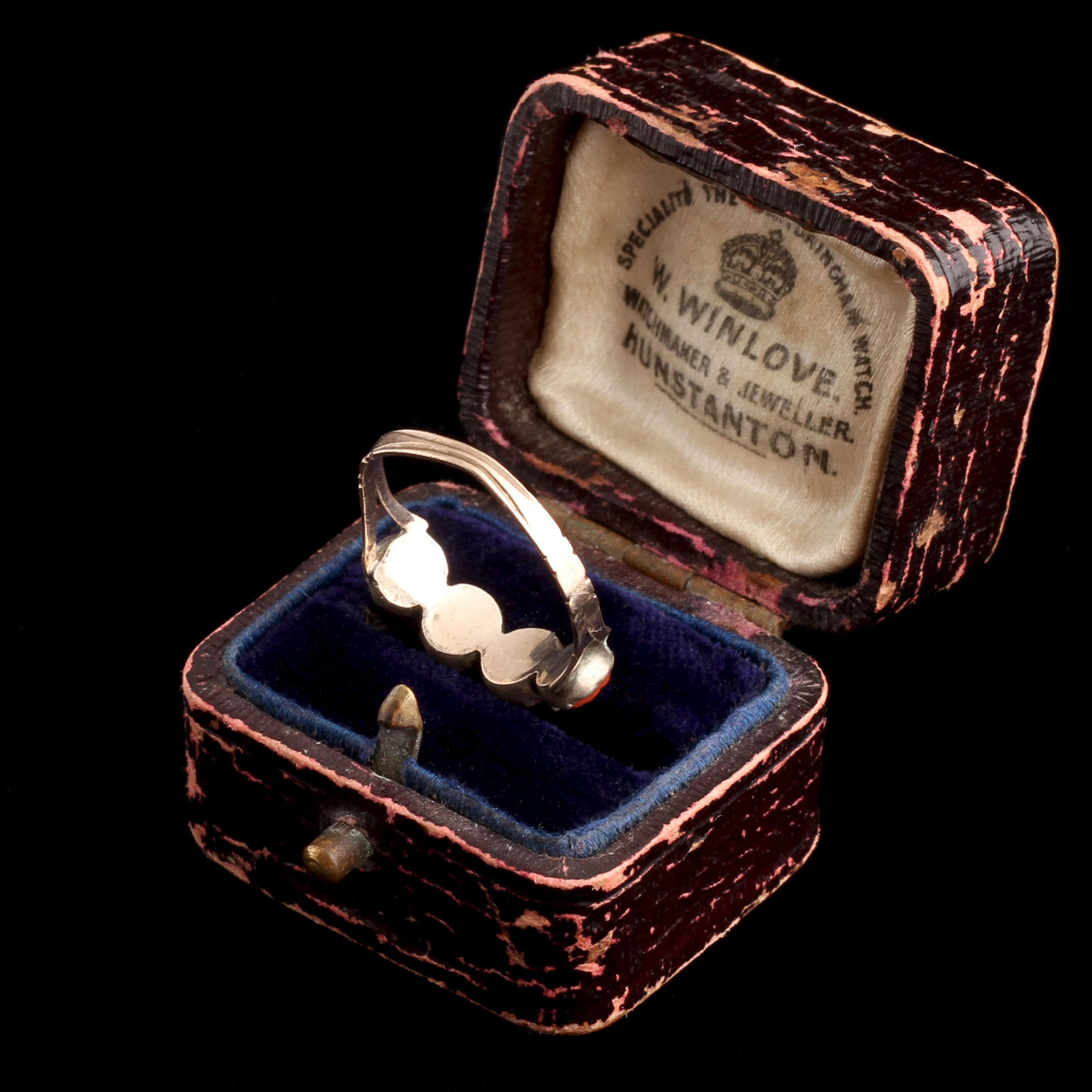
During the Roman era, branches of coral were hung around children’s necks to protect them from danger. By the Georgian period - when these coral cabochons were carved into rosettes - coral was still believed to possess protective powers. It remained a popular material for jewelry given to young women and children, who were thought to be especially vulnerable to illness. Each coral cabochon is gently carved with an abstract cross-hatched texture and set in a closed silver setting with a gold-washed interior. The split shoulders are characteristic of the period.
thedetails
- Materials
10k gold (tests), silver, 4 carved coral cabochons (2 4mm, 2 4.7mm)
- Age
c. 1820
- Condition
Very good - minor dent in the shank, engraved striations along the shank are worn away in places
- Size
6, can be resized; 5.3mm head, 1.8mm shank
Need more photos?
Send us an email to request photos of this piece on a model.
Aboutthe
GeorgianEra
1714 — 1837
As imperialist war raged in the Americas, Caribbean, Australia, and beyond, the jewelry industry benefited: colored gems from all over the empire became newly available. A mix of artistic influences from around Europe contributed to the feminine, glittering jewels of the era. Dense, ornate Baroque motifs from Italy showed up in Georgian jewelry, as did French Rococo’s undulating flora and fauna. Neoclassical style made use of Greek and Roman motifs, which were newly popular due to the recently uncovered ruins of Pompeii and Herculaneum. Lapidary methods improved: the dome-shaped rose cut was popular, as was the “old mine cut,” a very early iteration of today’s round brilliant cut.
The boat-shaped marquise diamond cut was developed around this time, supposedly to imitate the smile of Louis XV’s mistress, the marquise de Pompadour. Paste — an imitation gemstone made from leaded glass — was newly developed in the 18th century, and set into jewelry with the same creativity and care as its more precious counterparts. Real and imitation gems were almost always set in closed-backed settings, lined on the underside with thin sheets of foil to enhance the color of the stone and highlight it's sparkle. This makes Georgian rings tough for modern women to wear, especially on an everyday basis: genteel, jewelry-owning ladies of the 18th century were not famous for working with their hands like we are. Nor did they wash their hands as much as we do. Water will virtually ruin a foiled setting, so take special care with your Georgian ring. Very little jewelry from this period is still in circulation, and it's very difficult to repair.
please note:Terms of Sale
Antiques can be returned unworn and in original condition within 10 days of delivery for an exchange or refund minus the cost of shipping. Once a piece has been altered, including ring re-sizing, it is FINAL SALE.